
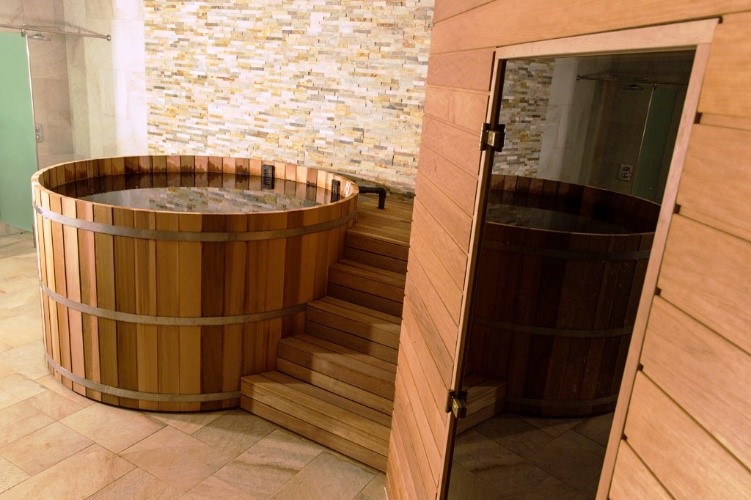
Which one to do first, how long to stay in each, how many rounds, how often per week, and who should not do it at all. This is the routine we give our own customers, from a shop that has built cedar saunas for 25 years.
Sauna first, then the cold plunge. A sauna and cold plunge session that works is 10 to 15 minutes in a traditional sauna at 170°F to 190°F, then a 1 to 2 minute breather, then 1 to 3 minutes in 50°F to 59°F water. Repeat for 2 to 3 rounds and finish on cold, so your body rewarms on its own. Two to four sessions a week is plenty. If you have heart disease, an arrhythmia, or uncontrolled blood pressure, ask your doctor before you start.
| Step | Beginner (first 2 to 4 weeks) | Experienced |
|---|---|---|
| Sauna round | 8 to 12 min at 160°F to 175°F | 12 to 20 min at 175°F to 195°F |
| Transition | 1 to 2 min to step out, walk, and rinse off | 30 to 60 seconds |
| Cold round | 30 to 90 seconds at 55°F to 60°F | 1 to 3 min at 45°F to 55°F |
| Rest between rounds | 3 to 5 min, air-dry, no hot shower | 2 to 5 min, air-dry |
| Rounds per session | 1 to 2 | 2 to 4 |
| Sessions per week | 2 | 3 to 4 |
| Finish on | Cold, then air-dry and dress in layers | Cold, then air-dry |
| Weekly cold total | 3 to 6 minutes | About 11 minutes |
Where this routine comes from
Finns have done this for centuries. Hot room, then the lake or a snowbank, then rest, then again. What’s new is the research. In the last decade, studies have measured what heat and cold do to your heart, your vessels, your hormones, and your fat.
We’ve built cedar barrel saunas for 25 years. Many of the people who buy our outdoor barrel saunas set a cold tub next to them, and I use one that way several nights a week. If you already own a sauna and are shopping for a tub, our post on choosing a cold plunge tub for your sauna covers the equipment side.
What contrast therapy is (and what the Nordic cycle means)
Contrast therapy is alternating heat and cold on purpose, most often a sauna followed by a cold plunge. Each swing opens the blood vessels near your skin, then clamps them down and pushes blood back to your core. That’s why people call it a pump.
In a physical therapy clinic, the term usually means hot and cold water baths on an injured limb. The whole-body version, sauna plus immersion, is what most people mean now, and it’s what the recent studies tested. The Nordic cycle is the three-part version of it. You sauna, then you plunge, then you rest, and you repeat that two or three times. The name comes from Finnish and Scandinavian sauna habits.
Air temperature and steam make a real sauna work harder than a hot shower. A traditional sauna runs 170°F to 195°F. Throwing water on the rocks, what the Finns call löyly, spikes the felt heat for a minute or two. Infrared cabins top out around 140°F with a milder sweat, so the swing is smaller. Our infrared vs traditional sauna comparison goes into that.
Sauna first or cold plunge first?
Sauna first, cold plunge second, for most people and most goals. There are three reasons.
First, you finish on cold, so your body has to rewarm itself. That rewarming is driven by shivering and brown fat, and it’s where researcher Susanna Søberg thinks the metabolic benefit comes from. Her advice, often quoted as the Søberg principle, is to end every session on cold and skip the hot shower afterward.
Second, the cold is easier to take when you walk in warm. The gasp can be sharper when your skin is hot, though, so walk in on a slow exhale rather than jumping. Third, cold water rinses off the sweat and closes the session cleanly. You’re dry and clear headed within twenty minutes, instead of dripping and slow to cool.
If you plunge in the morning to wake up, a short dip before the sauna is fine, because cold raises norepinephrine whichever order you use. Late in the evening, keep the last cold round short. A long plunge at night leaves some people too wired to sleep.
No clinical trial has compared the two orders head to head. Cold last has the better metabolic case, while warm last is safer for sleep. Either order works if you actually do it every week.
What happens in your body during a session
In the heat
Within ten minutes in a 180°F sauna, your heart rate climbs to 100 to 150 beats per minute. That’s brisk walk territory. Vessels near the skin open wide, blood pressure drops, and core temperature rises 1°F to 2°F. You can also lose a pound of sweat in one session. A 2015 study in JAMA Internal Medicine followed more than 2,300 Finnish men for 20 years. The ones who used a sauna four to seven times a week had about half the fatal cardiovascular events of the once-a-week users. That’s association rather than proof, but it’s a striking one.
In the cold
The first 30 to 60 seconds in cold water are the hardest, and they’re the part to respect. This is the cold shock response. You gasp, you breathe fast, and your heart rate and blood pressure jump. In a healthy person it fades within a minute or two as breathing settles. Meanwhile the vessels in your skin clamp down, blood shifts to your core, and stress hormones climb. A 2000 study in the European Journal of Applied Physiology found that an hour in 57°F water raised norepinephrine by about 530 percent and dopamine by about 250 percent. Notice the duration, though. That was a full hour in the water, not the two minutes most wellness blogs imply when they quote it. A short plunge gives a smaller but still sharp rise, and that’s why you feel alert and calm for hours afterward.
In the rewarm
Skip the shower and your body starts making its own heat. Muscles shiver, and brown fat, a tissue in the neck and upper back, burns fuel for warmth. A 2021 study in Cell Reports Medicine compared young men who swam in cold water and used a sauna two to three times a week with matched non-swimmers. The swimmers made more heat in the cold and burned more calories while cooling. They also averaged roughly 11 minutes of cold and 57 minutes of heat per week, which is where the usual weekly target comes from. The study was small and the calorie effect modest, so I read it as encouraging rather than settled.
The step-by-step sauna and cold plunge protocol
This is what we teach new owners. It assumes a traditional sauna and a tub of still water. For your first few weeks, lean toward the beginner column in the table above.
- Drink 16 ounces of water and eat something light one to two hours ahead. Skip alcohol. Put one thermometer in the water and one in the sauna, then lay out a towel, a robe, and non-slip sandals. Keep another adult nearby for your first several sessions.
- Sauna round one is 10 to 15 minutes. Sit low for the first few minutes, then move up, and breathe slowly through your nose. Leave once you’re sweating freely, because dizziness means you waited too long.
- Take 1 to 2 minutes to step outside and walk a few steps. Rinse the sweat off under a cool hose, so your plunge stays clean and your heart rate settles a little.
- Cold round one is 30 seconds to 3 minutes. Get in to your shoulders in one controlled motion with a long exhale, and keep your head above water. Stay 30 to 90 seconds if you’re new, or 1 to 3 minutes if you’re experienced. Colder water means less time, never more.
- Rest and rewarm for 2 to 5 minutes. Get out, stand or sit, and let your body do the work. No hot shower, because the shivering is part of the point.
- Repeat for 2 to 3 rounds. Shorten the sauna rounds a little as you go, to 8 to 10 minutes later on, and keep the cold rounds the same or slightly longer.
- Finish on cold. Air-dry for 5 to 10 minutes, then dress in layers and drink water with electrolytes. Expect to feel calm and clear, maybe a little euphoric, within the hour.
How cold the water should be
| Water temperature | How it feels | Time per round | Who it suits |
|---|---|---|---|
| 60°F to 65°F (16°C to 18°C) | Cool, bracing | 3 to 5 min | First two weeks, older adults, anyone nervous |
| 55°F to 60°F (13°C to 16°C) | Cold, gasp-inducing | 2 to 3 min | Most people, most of the time |
| 45°F to 55°F (7°C to 13°C) | Very cold | 1 to 2 min | Experienced plungers |
| 39°F to 45°F (4°C to 7°C) | Extreme | 30 to 90 seconds | Experienced, with someone present |
| Below 39°F (4°C) | Ice water | Not recommended | No added benefit shown, and real hypothermia and cardiac risk |
Colder water is not better water. The research effects show up at 50°F to 60°F. Going colder mostly shortens how long you can stay in, and it raises the risk. So pick a temperature you can hold for two calm minutes.
How often should you do sauna and cold plunge?
Two to four sessions a week, with at least one full rest day between them. The winter swimmers in the Søberg study did two to three sessions a week. That came to about 11 minutes of cold and 57 minutes of heat, and it’s a reasonable ceiling for most people. If you’re new, start with two sessions of one or two rounds. Add a round to those before you add another day.
Sauna on its own can be daily. The Finnish mortality data favored four to seven sessions a week, and frequent sauna doesn’t seem to hurt healthy adults who drink enough water. Cold is different. Long daily plunges add up to a real stress load, and the benefits don’t keep climbing with the dose. If you feel wiped out or your resting heart rate creeps up, cut the cold rounds in half for a week.
There’s one timing rule for lifters. In a 2015 study in the Journal of Physiology, men who did cold water immersion right after strength training for 12 weeks gained less muscle and strength than men who did light active recovery. So if muscle is a goal, keep the plunge four to six hours away from lifting, or put it on a different day. Sauna after training doesn’t seem to carry that downside.
What the research says about sauna and cold plunge benefits
Most articles list a dozen benefits and treat them all as proven. They aren’t. Here is where each one actually stands, and which half of the routine it comes from.
Benefit by benefit
| Benefit | Evidence | What the studies show |
|---|---|---|
| Heart and blood vessel health | Strong (sauna) | Frequent sauna use is linked to far lower rates of fatal heart disease, sudden cardiac death, and high blood pressure in long-term Finnish cohorts. A 2018 systematic review in Evidence-Based Complementary and Alternative Medicine found cardiovascular conditions had the most consistent benefit from regular dry sauna. Long-term data on cold alone is thin. |
| Muscle soreness and recovery | Moderate | A 2013 meta-analysis in PLoS ONE found contrast water therapy reduced soreness and strength loss after hard exercise compared with sitting still. It was not clearly better than cold water alone or active recovery. |
| Mood, alertness, stress tolerance | Strong for the short term | Cold immersion reliably spikes norepinephrine and dopamine, and people report hours of better mood. Long-term trials on depression and anxiety are small but promising. |
| Brown fat and metabolism | Emerging | Regular cold plus sauna users make more heat in the cold and burn more calories while cooling. Measurable, but modest. |
| Weight loss | Weak | The extra calories burned rewarming are real but small, tens of calories per session. Some people also eat more after cold exposure. |
| Fewer sick days | Moderate | A 2016 Dutch trial in PLoS ONE with 3,000 adults found that people who ended their daily shower with 30 to 90 seconds of cold reported 29 percent fewer sick days. The colds they did catch were no milder. |
| Better sleep | Moderate (sauna) | Evening sauna helps many people fall asleep as core temperature drops afterward. A long cold plunge late at night can do the opposite for some. |
| Lower inflammation | Mixed | Some inflammatory markers drop right after cold, but what happens over years is unclear. Sauna users show lower C-reactive protein in observational data. |
What we make of it
The strongest evidence belongs to the sauna half. Cold adds recovery and mood, and in my experience it’s also what makes the habit stick. So treat the metabolic and weight claims as a bonus. Our sauna health benefits page covers the heat side in depth.
Mistakes that make people quit (or get hurt)
Most people who quit started too cold. A 40°F plunge on day one is miserable and pointless. Start at 60°F instead, and drop a few degrees each week. Jumping in is the other big one. A dive or a dunk to the head sets off the strongest gasp reflex at the worst moment, so step in, shoulders deep, head up.
- Fast, shallow breathing through the shock drags the panic out. Long exhales settle it in 20 to 30 seconds.
- If you go straight from the cold back into the hot room, you waste the rewarm and can end up lightheaded.
- Feeling faint in the sauna means you missed the signal. Leave when you’re sweating freely, not when you’re woozy.
- Plunging right after lifting blunts muscle gains, so give it several hours.
- Alcohol dulls your judgment about time and temperature. It also raises the odds of fainting or an arrhythmia, in both heat and cold.
- Going solo in the early weeks is a bad bet, because most cold water incidents happen in the first minute.
- Dehydration is the most common reason people feel wrecked the next day. Sauna sweat losses are large, so drink before and after.
Who should skip it, or ask a doctor first
The sauna and cold plunge combination is safe for most healthy adults. Cold shock spikes heart rate and blood pressure for about a minute, and that lands on a heart already working harder from the heat. So the pair stresses it more than either one alone. Cardiologists are consistent on this point. People with established heart disease should not cold plunge without their doctor’s clearance.
Talk to your doctor before you start if you have
- coronary artery disease, a past heart attack or stroke, or heart failure
- any arrhythmia, including atrial fibrillation, or an implanted device
- high blood pressure that treatment isn’t keeping under control
- Raynaud’s disease, cold urticaria, or another cold-triggered condition
- diabetes with reduced feeling in your hands or feet, since cold injury can go unnoticed
- epilepsy, or a history of fainting
- a pregnancy, since core temperature above about 102°F is a first-trimester concern and cold immersion has no safety data in pregnancy at all
Three rules apply to everyone. Never plunge after alcohol or sedatives. Never put your head under or hold your breath underwater. And stop at the first sign of chest pain, an irregular heartbeat, confusion, or shivering that hasn’t stopped ten minutes after you get out. The cold water physiologist Mike Tipton titled his 2017 review in Experimental Physiology “Cold water immersion: kill or cure?” for a reason. The same response that makes cold feel invigorating is the one that causes trouble in a vulnerable heart.
Setting up a sauna and cold plunge at home
The sauna side
The best version of this routine is the one you do barefoot, ten steps from your back door. Most people build it around an outdoor barrel sauna. A wood-fired sauna heater takes a barrel to 190°F in 30 to 45 minutes with no wiring, while an electric heater does it on a timer while you finish dinner. Our sauna heater guide compares the two. Our site preparation guide covers the pad, clearances, and drainage.
The cold side
| Option | Typical cost | Temperature control | Notes |
|---|---|---|---|
| Stock tank or insulated tub with ice | $150 to $600 | Manual, with ice, shade, and cold hose water | Cheapest way to start. You’ll buy a lot of ice in summer, but in a cold climate the water chills itself half the year. |
| Insulated tub with a chiller | $3,000 to $9,000 | Set and hold, 39°F to 60°F | Filtration and ozone keep the water clean for weeks. Needs a GFCI outlet. |
| Converted chest freezer | $300 to $900 | Timer-controlled | Popular online. It mixes electricity, water, and a lid that can close on you. Bad idea, and we won’t recommend it. |
| Lake, river, or snow | Free | Whatever the season gives you | The original. Watch for current and know your exit before you get in. |
Layout details that matter
Put the tub 10 to 15 feet from the sauna door. That’s close enough to reach in seconds, but far enough that splashing doesn’t soak the cedar. Run a non-slip path between the two, because wet feet on smooth stone are the most common injury. Add a bench for the rest phase, plus a hose bib within reach and a drain that won’t undermine the sauna pad. Keep one thermometer floating in the tub and one in the sauna, since guessing is how people overdo both. A fence or screen gives you privacy and blocks the wind, which lets you rewarm on your own terms.
Still deciding between a barrel and a cabin, or wood and electric? Our guide to barrel saunas walks through it, and our barrel sauna kits page shows what ships to your driveway.
Frequently asked questions
Should you cold plunge or sauna first?
Sauna first for most people. Heat makes the cold easier to take, and finishing on cold forces your body to rewarm itself, which is where the metabolic benefit seems to come from. Cold first is fine if you just want to wake up. No trial has compared the two orders.
How long should you cold plunge after a sauna?
One to three minutes at 50°F to 59°F for most people. When you’re new, 30 to 90 seconds. Stay long enough for your breathing to settle after the first 30 seconds, then a little more. Get out at the first sign of numb hands or feet, or shivering you can’t stop.
Can you do sauna and cold plunge every day?
Sauna, yes. The Finnish data favored four to seven sessions a week. Daily cold is different, because long plunges every day pile up stress and the benefits don’t keep climbing. Two to four combined sessions a week, about 11 minutes of cold and 57 minutes of sauna in total, is the target we give people.
Why am I so tired after a sauna and cold plunge session?
Usually dehydration, sometimes too many rounds, or the crash after a big adrenaline spike. You lost a pound of sweat and then ran your stress hormones up and down, and that’s hard work. Drink water with electrolytes, eat, and drop to two rounds. If you sleep all day after every session, the dose is too high.
Does sauna and cold plunge burn fat?
A little. Rewarming after cold switches on brown fat and burns extra calories, but the amount is small, in the tens of calories per session. It can help a fat loss plan through better sleep and recovery, though some people eat more after cold exposure. It doesn’t replace diet and training.
Is it safe to go straight from a hot sauna into a cold plunge?
For healthy adults, yes, if you get in under control, keep your head above water, and breathe slowly through the first 30 seconds. Cold pushes heart rate and blood pressure up sharply for about a minute. If you have heart disease, an arrhythmia, or uncontrolled blood pressure, get a doctor’s clearance first.
Can you sauna and cold plunge while pregnant?
Not without your obstetrician’s approval. Raising core temperature above about 102°F in the first trimester is linked to birth defects, and cold water immersion has no safety research in pregnancy at all. The obstetricians we’ve asked tell patients to skip both until after delivery, so we tell our customers the same.
Is sauna and cold plunge good when you have a cold?
Skip it while you have a fever or feel run down. Heat and cold both add stress your body doesn’t need while it’s fighting something. Once the fever is gone, a gentle sauna can feel good for mild congestion. Save the cold plunge until you’re fully recovered.
Which is better, sauna or cold plunge?
They do different jobs. Sauna has the stronger evidence over decades, especially for the heart, while cold plunge has the stronger immediate effect on mood and alertness. Together they cover both. That’s probably why Finns never stopped doing it, and why the combination has outlasted every fitness trend around it.
How many rounds of sauna and cold plunge should you do?
Two to three rounds. Beginners should do one or two. Past three, fatigue climbs and the benefits level off, and you’ll feel it the next morning. Shorten the sauna rounds a little as you go, to 8 to 10 minutes, and keep the cold rounds steady.
Start warm, end cold, keep it simple
The routine that sticks is the one that fits your evening. Light the stove and wait for 180°F. Sit until you glisten, then walk ten steps to the cold water and breathe through the first half minute. After that, stand in the air and let the shivering do its work. Two or three nights a week is enough. It’s about what the winter swimmers in the 2021 Cell Reports Medicine study did, and it’s what I do.
We’ve shipped cedar barrel saunas to backyards across North America for 25 years. See barrel sauna pricing, or call 800-759-8990 and tell us where the tub is going. We’ll help you plan the rest.