
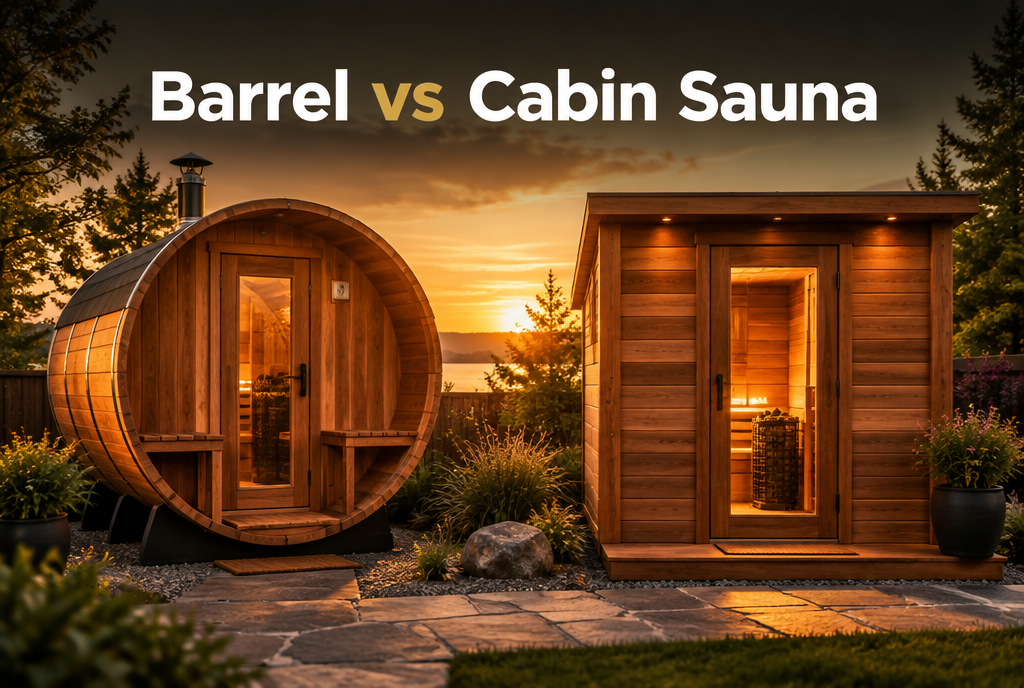
A barrel sauna heats faster and costs less because its curved shell holds roughly a quarter less air, so it suits smaller yards and tighter budgets. A cabin sauna gives you standing headroom, thicker insulation and a rectangular layout that holds heat better in deep winter cold. Buy a barrel for value and quick sessions, a cabin for space, comfort and hard-climate performance.
We build cedar saunas for a living, and this is the question we get more than any other. Both shapes make a genuinely good sauna, so the honest answer depends on your yard, your climate and what you want the room to feel like. Below we lay out the trade-offs the way we would explain them across the workbench, with real 2026 market numbers and no thumb on the scale for either side.
What is the real difference between a barrel sauna and a cabin sauna
A barrel sauna is built from cedar staves drawn tight around a round frame and held by steel bands, so the whole room is a horizontal cylinder. A cabin sauna, sometimes called a box or square sauna, is framed like a small building with flat walls, a roof and an insulated wall cavity. That one structural choice drives almost every difference that follows, from how fast the room warms up to how it sheds snow. If you are new to the round shape, our plain-language guide to what barrel saunas are covers the basics, and we walk through the advantages of a barrel sauna in more depth. If you are also weighing heat styles, our comparison of a dry sauna versus a barrel sauna is worth a read before you commit.
Which heats up faster, a barrel or a cabin sauna
The barrel wins on warm-up, and it is not close. A cylinder holds about 23 to 30 percent less air than a rectangular cabin with the same usable bench space, and the round wall pushes heat in a natural convection loop back over the bathers. In practice a barrel reaches a working 180 to 190 degrees Fahrenheit in about 30 to 45 minutes, roughly 30 to 45 percent quicker than a comparable cabin. Less air to heat also means a smaller heater and a lower power bill on warm-up.
A cabin is slower to reach temperature because there is more air in the room, but a well-insulated cabin holds that heat longer once it gets there, which matters if you like long sessions or you live somewhere cold. Sizing the heater correctly is what makes either shape comfortable. A good rule is about 1 kilowatt for every 45 to 50 cubic feet of well-insulated interior, then add 10 to 20 percent for an outdoor build or a lot of glass. Our sauna heater sizing chart turns your room dimensions into the right kilowatt number in a minute.
Barrel sauna vs cabin sauna compared side by side
Here is the head-to-head we run through with buyers. Treat the prices as general 2026 market ranges rather than exact quotes, and check our current sauna pricing page for live numbers on our own models.
| Factor | Barrel sauna | Cabin sauna |
|---|---|---|
| Heat-up time | About 30 to 45 minutes to reach 180 to 190 F, roughly 30 to 45 percent faster | About 40 to 60 minutes, more air to warm before it is ready |
| Efficiency and air volume | Cylinder holds about 23 to 30 percent less air, so warm-up uses less power | More air volume, needs a larger heater and slightly more energy per session |
| Headroom | Curved ceiling, you sit rather than stand, tight near the edges | Flat ceiling with full standing headroom in taller models |
| Cold-climate performance | Curved roof sheds snow on its own, but staves need a tight seal to hold heat below zero | Thicker walls, vapor barrier and door seals hold heat best in deep cold |
| Footprint | Compact and round, fits tight yards, decks and side returns | Larger rectangular footprint, room for benches, a changing area or a porch |
| Price (installed ranges) | Kits roughly $3,500 to $8,000, assembled cedar barrels about $6,000 to $15,000 | Roughly $6,000 to $25,000 depending on size, insulation and features |
| Resale and curb appeal | Strong wow factor, a distinctive shape that stands out in listing photos | Safest all-round choice, blends with modern and rustic yards alike |
Is a barrel or cabin sauna better for winter
This is where climate settles the argument for a lot of our Canadian and northern US customers. The barrel has one clear winter strength, which is that its curved roof sheds snow and rain on its own, with no flat span for water to pond on and no membrane to maintain. It also warms up fast on a frigid night, so you are sweating sooner. The catch is the seal. A barrel relies on tight stave-and-hoop joinery, and a loose or aging barrel bleeds heat quickly when it is well below freezing.
A cabin is the stronger performer in hard cold. Framed walls take real insulation, a proper vapor barrier and a tight weatherstripped door, so the room holds a steady temperature even when it is minus 20 outside. If you sauna through long, brutal winters, that stability is worth the slower warm-up. We compare the field in detail in our guide to the best outdoor saunas for cold climates and Canadian winters, and you can browse both shapes on our outdoor saunas page.
Which gives you more headroom and usable space, a barrel or box sauna
A barrel is a sitting sauna. The round ceiling is generous over the center bench but drops away fast toward the walls, so tall bathers duck near the ends and standing up is awkward. That geometry is fine for most people, since you spend a sauna session sitting or lying down anyway, and it is part of why the room heats so evenly. A cabin gives you flat walls and, in taller models, real standing headroom, which makes it easier to step in, add an upper bench and move around. If headroom is a deciding factor, read our notes on sauna room height before you pick a model.
Footprint is the flip side. A barrel packs a lot of bench into a small round outline, so it wins in tight yards, on decks and along a side return. A cabin needs more ground but rewards it with layout freedom, whether that is an L-shaped bench, a changing bay or a covered porch. Matching either shape to the number of people you actually seat is the real trick, and it feeds straight into heater size and cost.
How much does each one cost and which holds its value better
On sticker price the barrel usually comes in lower. In 2026 barrel kits run roughly $3,500 to $8,000, assembled cedar barrels land around $6,000 to $15,000, and premium custom barrels climb toward $18,000 and up. Cabins span a wider band, roughly $6,000 to $25,000, because insulation, roofing and extra square footage all add material and labor. Whichever you choose, budget another $300 to $1,000 for a level foundation and $400 to $900 for the electrical hookup. For a full breakdown, see our sibling guide on how much a barrel sauna costs in 2026, and if you are weighing the whole decision, our pillar on whether a home sauna is worth it lays out the real return.
Running cost is close between the two, and modest either way. At average US power rates a traditional electric session costs somewhere around a dollar to a dollar fifty, so four sessions a week land near 20 to 25 dollars a month. The barrel edges ahead on warm-up because it heats less air.
| Detail | Barrel sauna | Cabin sauna |
|---|---|---|
| Typical heater size | About 4.5 to 8 kW for a 2 to 6 person room | About 6 to 9 kW, more air to heat |
| Dedicated circuit | 240V line, 40A double-pole breaker for a 6 kW heater | 240V line, 50A double-pole breaker for an 8 kW heater |
| Rough running cost | About $1.00 to $1.50 per session | Slightly higher, a bigger heater and more air |
On resale it is a genuine toss-up. A barrel is the eye-catcher that photographs beautifully and reads as a premium backyard feature. A cabin is the safe long-term bet because its shape suits any yard and any future owner. A home sauna of either kind can add real value, often in the $5,000 to $20,000 range, when it is built well and wired properly.
Which is easier to maintain, a barrel or a cabin sauna
Both are low-fuss if the cedar is good and you air the room out after use. The barrel has fewer flat surfaces to catch water and its curved roof drains itself, though the steel hoops want a check and a light re-tightening as the wood settles in its first year. A cabin has more seams, a roof and a floor to keep sealed, but its flat surfaces are simple to wipe down and re-coat. Cedar does the heavy lifting on both, which is why we care so much about the cedar we use for saunas. Our routine for keeping a sauna room in shape applies equally to either build.
So which sauna should you buy
Buy a barrel if your yard is tight, your budget is lean, you love the look and you want to be sweating fast on a weeknight. Buy a cabin if you want standing room, you sauna through brutal winters, or you plan to seat a crowd and add a bench layout or changing space. There is no wrong answer here, only the one that fits your space and your winters. When you are ready to look at real models, browse our barrel sauna kits or, if the sauna is going inside, our indoor saunas.
Frequently asked questions
Is a barrel or cabin sauna better
Neither is better outright. A barrel heats faster, costs less and fits small yards, while a cabin offers standing headroom, stronger insulation and better performance in deep cold. Pick the barrel for value and quick sessions, the cabin for space, comfort and hard winters. Both make an excellent cedar sauna when built well.
Which heats up faster, a barrel or a cabin sauna
The barrel heats faster. Its cylindrical shape holds about 23 to 30 percent less air and moves heat in a natural convection loop, so it reaches a working 180 to 190 degrees in roughly 30 to 45 minutes. A comparable cabin usually needs 40 to 60 minutes because there is more air to warm.
What is the difference between a barrel and a square sauna
A barrel sauna is a round cedar cylinder built from staves and steel bands, while a square or box sauna is framed with flat, insulated walls and a roof. The barrel warms faster and fits tight spaces. The square cabin gives you standing headroom, a flexible bench layout and stronger insulation for cold climates.
Is a barrel or cabin sauna better for winter
Both work in winter, but they win differently. A barrel sheds snow on its curved roof and warms up fast on a cold night. A cabin holds a steady temperature far better in deep cold thanks to thicker walls, a vapor barrier and a tight door. For brutal winters, the insulated cabin is the safer pick.
Which sauna shape holds its value better
It is close. A barrel has strong wow factor and photographs well, which helps a listing stand out. A cabin blends with any yard style and reads as a safe, permanent feature to future buyers. Built well and wired properly, either shape can add real value to your home, often several thousand dollars.
Which is easier to maintain, a barrel or a cabin sauna
Both are low-maintenance with good cedar. A barrel has fewer flat surfaces and a self-draining curved roof, but the steel hoops need a check and light re-tightening in the first year. A cabin has more seams and a roof to keep sealed, though its flat walls are simple to wipe down and re-coat over time.
How much does a barrel sauna cost compared to a cabin sauna
In 2026 barrel kits run about $3,500 to $8,000 and assembled cedar barrels about $6,000 to $15,000. Cabins span a wider $6,000 to $25,000 because of insulation and roofing. Budget more for a foundation and electrical on either one. Check our pricing page for live numbers on our own current models.
Do you need a special electrical circuit for either one
Yes, a traditional electric sauna of either shape needs its own dedicated 240 volt circuit on a double-pole breaker. A 6 kilowatt heater typically wants a 40 amp breaker and an 8 kilowatt heater a 50 amp breaker, sized at 125 percent of the load. Always have a licensed electrician confirm the wiring against local code.