Financing as Low as 0% APR on Approved Credit. Find out More.
Terms and conditions apply. See details here.
Financing as Low as 0% APR on Approved Credit. Find out More.


Have some extra space, and want to add an indoor sauna to your home? No problem! Our pre-cut packages are available in any size, or to any custom modification. Northern Lights sauna packages are equipped with everything you will need to finish the interior of your sauna room.
Scroll down to see how you can best plan for your indoor sauna!!

A genuine Finnish sauna is relatively inexpensive, and it can be built to fit any space or surrounding. The size depends on the number of people likely to use it at the same time.
The top bench should be at least 20” wide and 36” from the floor. Benches are placed on wall supports and legs if needed. 2” x 4” cedar with 1/2” space between the boards is recommended. The cubic footage of the sauna room is very important in determining the capacity of the heating unit.
BENCH TIP:
The upper and lower benches are the main components you will use to sit and lay down in the sauna. Remember that most sauna users like to stretch out on the upper and lower benches, so try to have the main bench wall 6 feet or longer.


The top bench should be at least 20” wide and 36” from the floor. Benches are placed on wall supports and legs if needed. 2” x 4” cedar with 1/2” space between the boards is recommended. The cubic footage of the sauna room is very important in determining the capacity of the heating unit.
BENCH TIP:
The upper and lower benches are the main components you will use to sit and lay down in the sauna. Remember that most sauna users like to stretch out on the upper and lower benches, so try to have the main bench wall 6 feet or longer.
Ventilation in a sauna room is extremely important. Not only for your satisfaction and pleasure, but also in the speed it takes to reheat the sauna room.
Lack of fresh air due to insufficient ventilation or poor management of ventilation can create an uncomfortable feeling. This often results in the symptoms of difficulty in breathing, or burning of the skin.
The expanded hot air in the sauna contains proportionately less oxygen than the denser atmosphere outside. Sauna bathers sometimes experience faintness unless the air is changed regularly. Normally two ventilators are built into the walls, as the amount of fresh air that enters with door being opened is insufficient.
The inlet should be located below the heating unit (Commonly a bottom gap in the sauna door or a door vent) and the outlet is located on the opposite side, on the ceiling or just below the ceiling.
Recommended ventilation openings are 4” to 6” diameter, depending on the size of the sauna room.
The ceiling height for a sauna can be from 6 1/2 to a maximum 7 feet high. Because heat rises, you want the benefit of the warmer air in the sauna while you are laying on the upper bench, so a ceiling height of 8 or 9 feet is going to defeat this, plus your heater will not function properly.
Ventilation in a sauna room is extremely important. Not only for your satisfaction and pleasure, but also in the speed it takes to reheat the sauna room.
Lack of fresh air due to insufficient ventilation or poor management of ventilation can create an uncomfortable feeling. This often results in the symptoms of difficulty in breathing, or burning of the skin.
The expanded hot air in the sauna contains proportionately less oxygen than the denser atmosphere outside. Sauna bathers sometimes experience faintness unless the air is changed regularly. Normally two ventilators are built into the walls, as the amount of fresh air that enters with door being opened is insufficient.
The inlet should be located below the heating unit (Commonly a bottom gap in the sauna door or a door vent) and the outlet is located on the opposite side, on the ceiling or just below the ceiling.
Recommended ventilation openings are 4” to 6” diameter, depending on the size of the sauna room.
The ceiling height for a sauna can be from 6 1/2 to a maximum 7 feet high. Because heat rises, you want the benefit of the warmer air in the sauna while you are laying on the upper bench, so a ceiling height of 8 or 9 feet is going to defeat this, plus your heater will not function properly.
Within reason, try to keep your room smaller rather than larger. After allowing for the depth of each bench, (typically 19" each) you should then plan on space for your heater, plus an area of 4" around the front, and two sides for the fence guard.
A smaller room will also permit using a smaller heater, smaller circuit breakers in your panel, and provide more efficient heating.
EXAMPLE ROOM
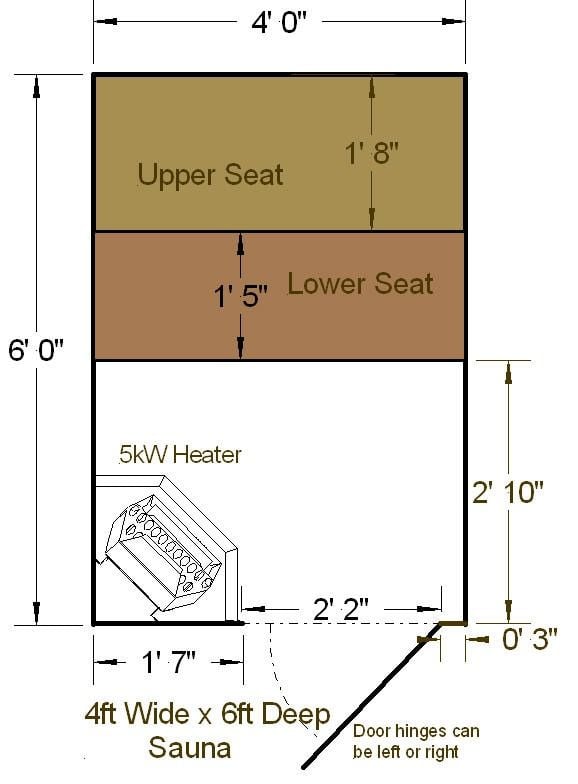
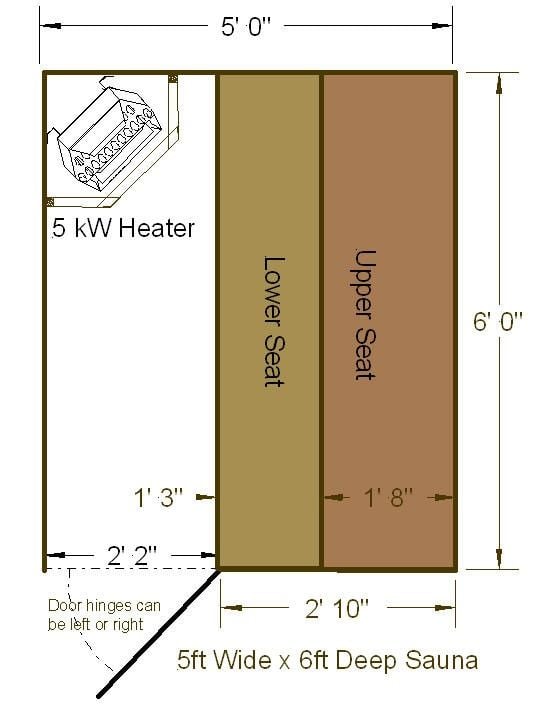
Let's plan a room 6 ft x 5 ft. The 6 foot wall will allow one upper and one lower bench, each 6 feet long, ideal for laying down. The 5 foot (60") side wall space will be used up by: a)20" wide upper bench, and b)19" wide lower bench, leaving 21" of space for the heater and safety clearance. "perfect" (60" - 20" - 19" = 21")


Our sauna room packages come pre-sized with the optimum heater for the given cubic space (assume 7' ceiling).
Our indoor sauna kits are available with two heating options – electric and infrared.

Our sauna room packages come pre-sized with the optimum heater for the given cubic space (assume 7' ceiling).

Saunas can be virtually any size or shape.
PRO TIP:
If you enjoy lying down in your sauna, allow 6' in at least one direction.

A sauna door MUST swing out of the room, not into the room.

Ideal heater location is near the door wall. Cool air will be naturally drawn from the door, along the floor to the heater where it will be heated and naturally rise to the ceiling.

Normal bench depth is 20"; height is either 36" ( for the upper bench) or 19" high (for the lower bench). Custom sizes are available, too!
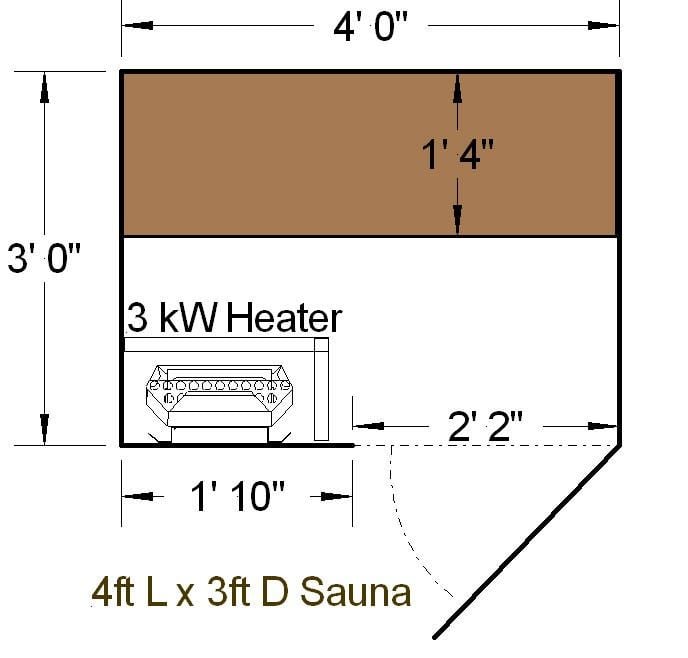
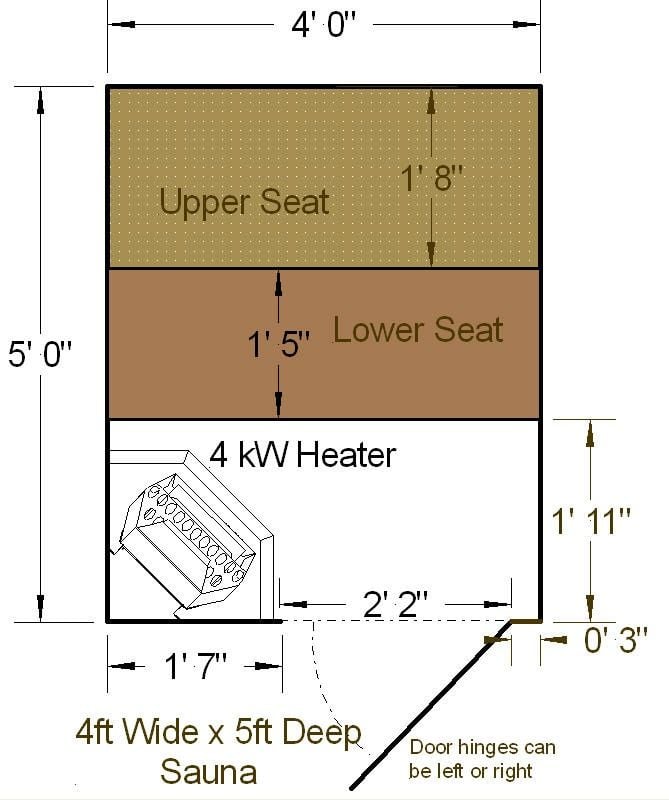
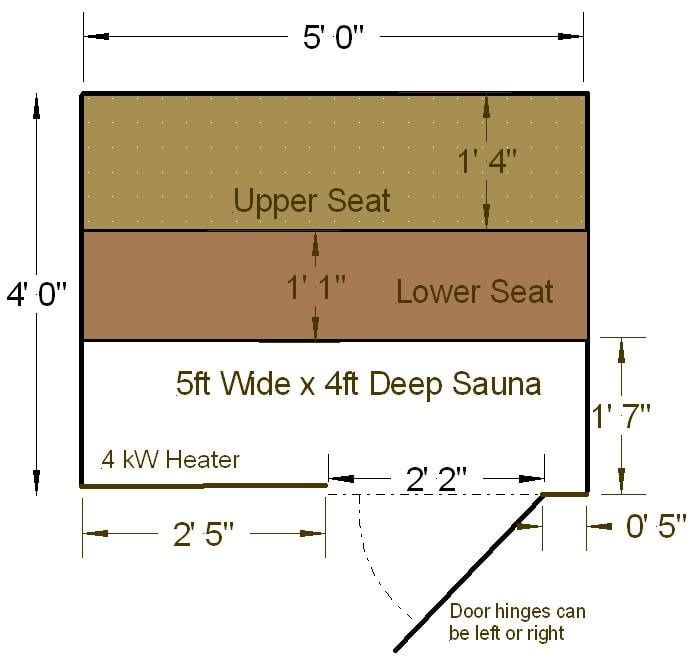
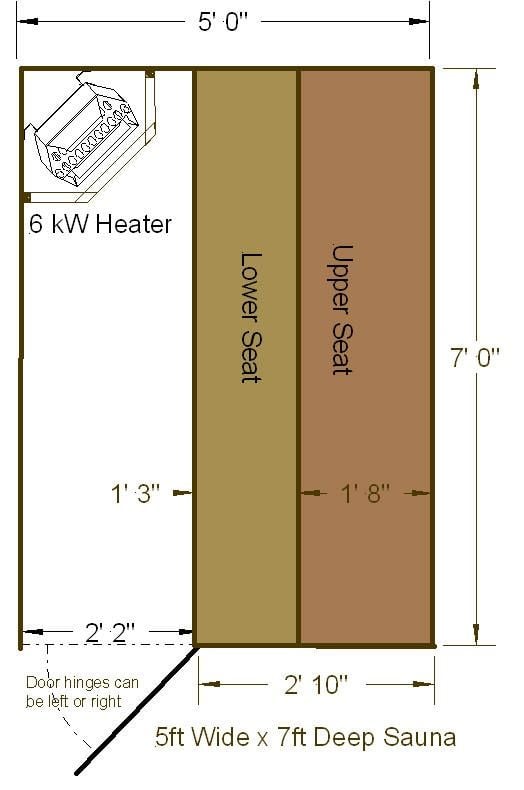
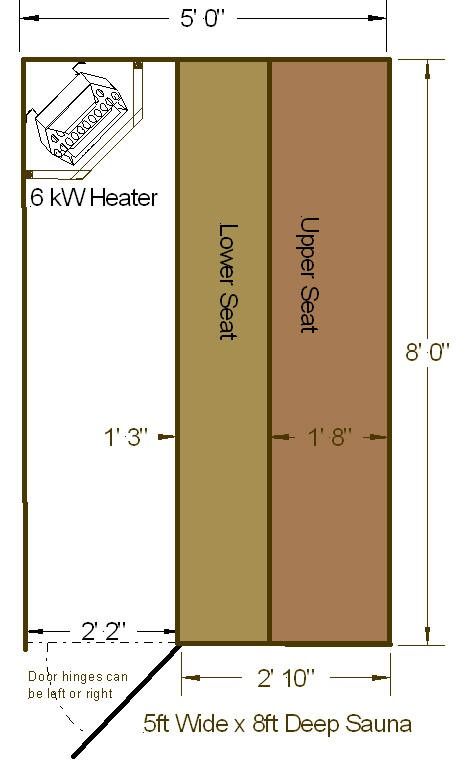
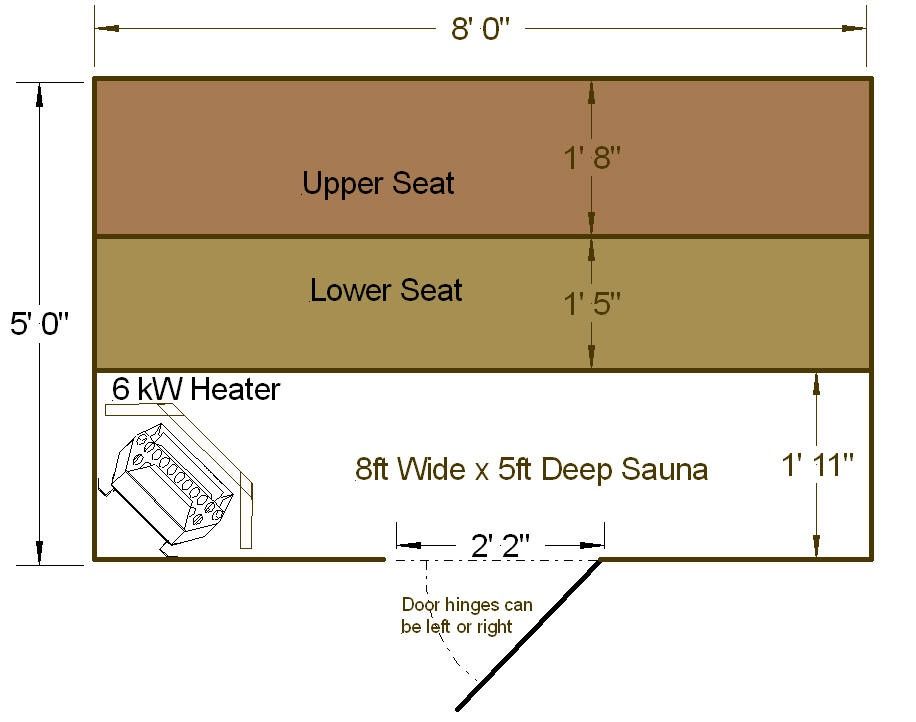
Below are some of our most popular sauna kit designs, however, we can do any size of sauna including large commercial saunas and saunas with 5 walls.
Call us to discuss your requirements: +1 (800) 759-8990